If you are shopping for an RV, a shore-power cord, or an adapter, the 30-amp vs 50-amp question sounds simple. It is not just “20 more amps.” A 50-amp RV service delivers roughly three times the usable power of a 30-amp service, and that difference decides whether you can run a second air conditioner, an electric water heater, and a microwave at the same time or whether you will be playing breaker roulette on a hot afternoon.
I’m Michelle Johnson with the SpecMyRig research desk. We compare manufacturer specifications, electrical ratings, and owner feedback rather than claiming hands-on lab testing. See how we review and our affiliate disclosure.
Quick verdict: 30-amp vs 50-amp RV plug
Choose 50-amp service if your RV has two roof air conditioners, a washer/dryer, an electric fireplace, a residential refrigerator plus other heavy loads, or if you simply do not want to manage power. Choose 30-amp service if your rig has one air conditioner, a propane/electric fridge, and mostly light loads. The right answer is set by the RV’s factory electrical system first; a plug or adapter cannot upgrade a 30-amp RV into a 50-amp RV.
The math is key: 30 amps × 120 volts = 3,600 watts. A 50-amp service has two 120-volt legs at 50 amps each, for 12,000 watts—about 3.3 times the power.
Comparison table
| Feature | 30-amp RV service | 50-amp RV service |
|---|---|---|
| Plug type | NEMA TT-30, 3 prongs | NEMA 14-50, 4 prongs |
| Electrical supply | One 120-volt hot leg | Two 120-volt hot legs, 240 volts leg-to-leg |
| Maximum power | 3,600 watts | 12,000 watts |
| Practical continuous planning | About 2,880 watts at 80% | About 9,600 watts total at 80% |
| Typical RVs | Small and mid-size travel trailers, many Class B and C motorhomes | Large fifth wheels, Class A motorhomes, multi-AC rigs |
| Air conditioners | Usually one at a time | Two or more, depending on the RV |
| Cord handling | Lighter, easier to store | Heavier and bulkier |
| Adapter reality | Can plug into a 50-amp pedestal with an adapter, still limited to 30 amps | Can plug into a 30-amp pedestal with an adapter, limited to 3,600 watts total |
Winner by use case
Best for one air conditioner and simple camping: 30 amp
A 30-amp rig works well for many couples and small families. You can run one roof air conditioner, the converter/charger, lights, TV, and a fridge. The limit appears when a second big load starts: a microwave, hair dryer, electric water-heater element, space heater, or coffee maker. Owners who camp in mild weather and stagger appliance use often never miss 50-amp service.
Best for hot climates and full-time comfort: 50 amp
50-amp service wins when comfort loads stack up. Two air conditioners are the obvious dividing line, but the same applies to electric heat, a washer/dryer, an induction cooktop, or a residential fridge. If two similar RVs differ mainly by factory 50-amp wiring and a second AC, the 50-amp rig is usually easier to live with in summer.
Best for boondocking and generator use: it depends
Off-grid, plug size matters less than your inverter, batteries, and generator. A 50-amp RV can run from a smaller generator, but you will manage loads as you would on a 30-amp pedestal. Size a generator to the loads you will actually run together, not automatically to 12,000 watts.
What can you run on each service?
Exact draws vary, so use nameplate watts or amps when you can. As planning examples, a 13,500 BTU roof air conditioner often draws roughly 1,300–1,700 running watts and more at startup. A microwave may draw 1,200–1,500 watts, an electric water-heater element about 1,400 watts, and a hair dryer 1,500 watts or more. On 30-amp service, the air conditioner plus one big load may already approach the limit once the converter and fridge are added. On 50-amp service, loads split across two legs, though branch breakers still protect individual circuits.
Adapters: what they can and cannot do
Adapters only change the physical connection. A 30-amp RV plugged into a 50-amp pedestal through the correct adapter is still a 30-amp RV; its main breaker and wiring remain the limit. A 50-amp RV plugged into a 30-amp pedestal is limited to 3,600 watts total, even though both sides of its panel may be energized by the adapter. In that setup, run one air conditioner, switch the water heater to propane if equipped, and avoid stacking microwave, dryer, and electric heat.
Buy adapters by exact plug and receptacle names. Inspect for heat damage, loose blades, cracked housings, and cords that feel hot under load.
Safety notes
- Never try to “convert” a 30-amp RV to 50 amps by swapping only the plug. A real conversion can involve the inlet, cord, main panel, wiring, and transfer switch, and should be evaluated by a qualified RV technician or electrician.
- Use an RV-rated surge protector or electrical management system matched to your service size. Pedestal problems such as low voltage, reverse polarity, or an open neutral can damage appliances.
- Turn the pedestal breaker off before plugging in or unplugging, then switch it on after the connection is seated.
- Stop if a plug is hot, melted, buzzing, or repeatedly trips a breaker.
Best 5 RV shore-power adapters and cords
These five picks cover the adapters and extension cords that solve the common pedestal mismatches in this guide. An adapter changes the plug shape only; it does not turn 30-amp service into 50-amp service.
1. Camco PowerGrip Dogbone Adapter 55175
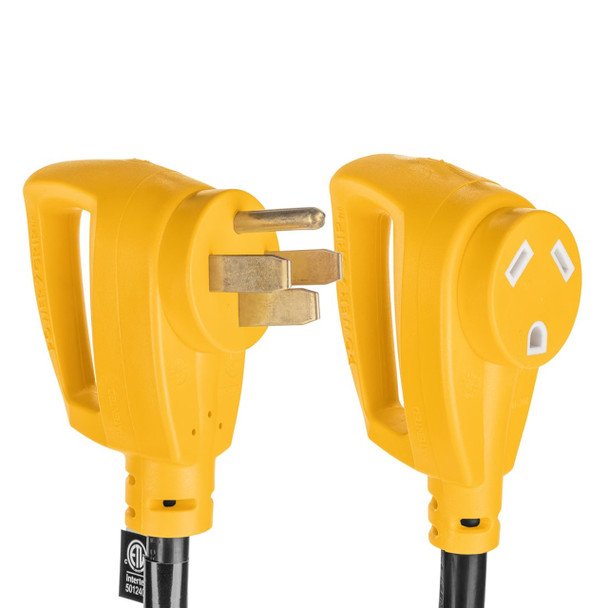
Best for: 30-amp RVs connecting to a 50-amp pedestal.
- 50A male NEMA 14-50P to 30A female NEMA TT-30R
- 18-inch dogbone adapter
- 100% copper 10/3-gauge wires
- Rated 125V / 3,750W with PowerGrip handles
2. Camco PowerGrip Dogbone Adapter 55185
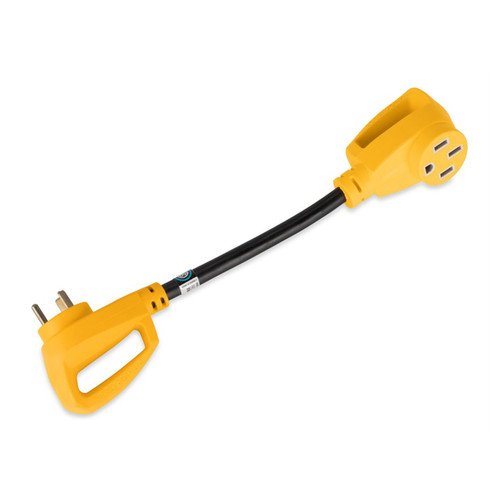
Best for: 50-amp RVs connecting to a 30-amp pedestal at reduced load.
- 30A male NEMA TT-30P to 50A female NEMA 14-50R
- 18-inch dogbone adapter
- 100% copper 10/3-gauge wires
- Rated 125V / 3,750W with PowerGrip handles
3. Conntek 14361 30-Amp RV Extension Cord
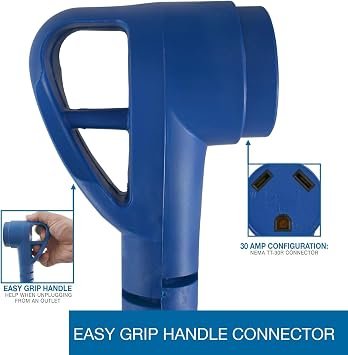
Best for: 30-amp RVs needing extra reach to a distant pedestal.
- 25 ft RV extension cord
- NEMA TT-30P plug to NEMA TT-30R receptacle
- 10/3 conductors rated 125V / 3,750W
- Elbow plug face and flanged griplets for strain relief
4. Camco Power Grip 50-Amp Extension Cord 55195
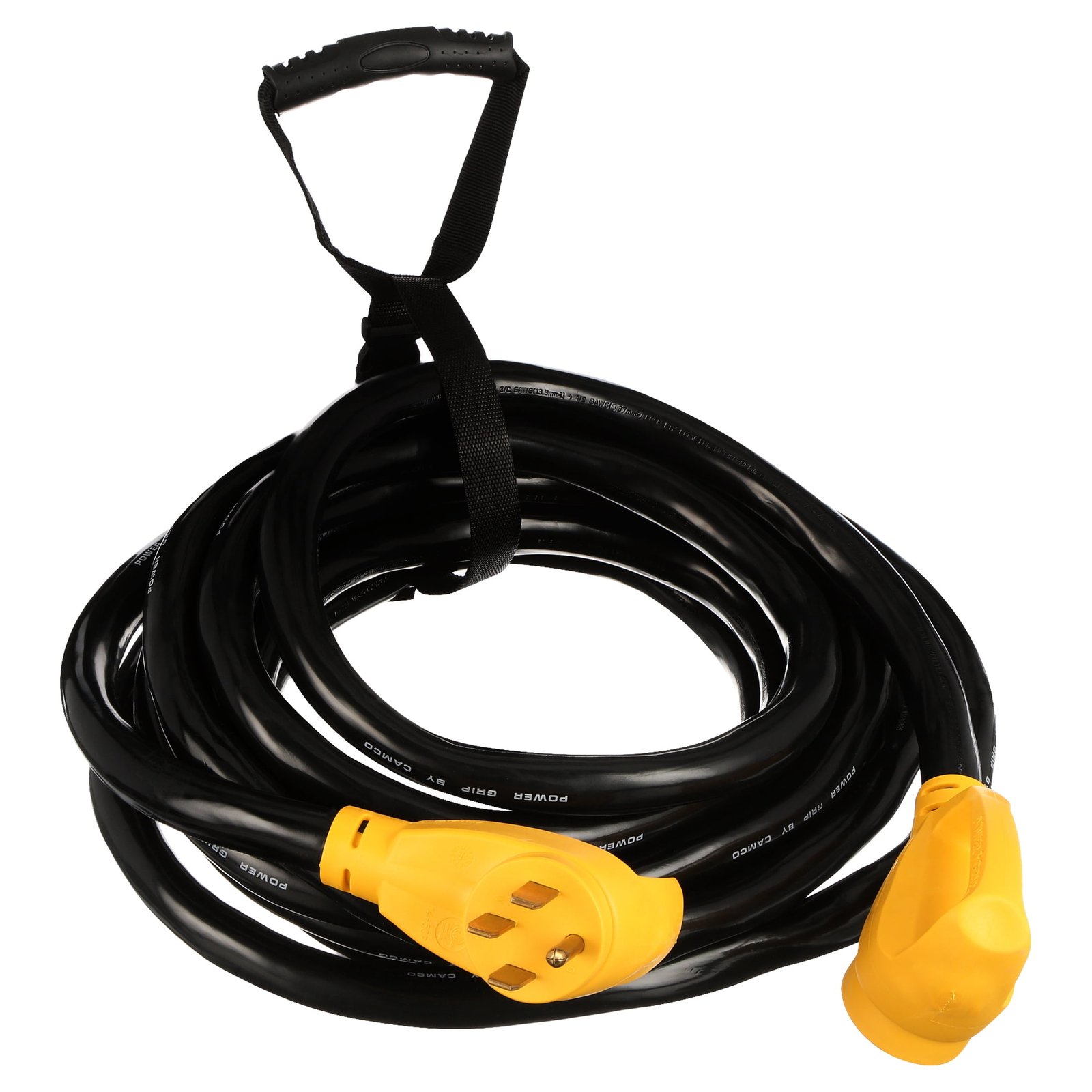
Best for: 50-amp RVs needing a longer shore-power reach.
- 30 ft 50-amp extension cord
- NEMA 14-50P male to NEMA 14-50R female
- Copper 6/3 + 8/1-gauge wires
- Rated 125/250V / 12,500W with heat-resilient PVC jacket
5. Kohree 30-Amp to 50-Amp RV Plug Adapter VHP488
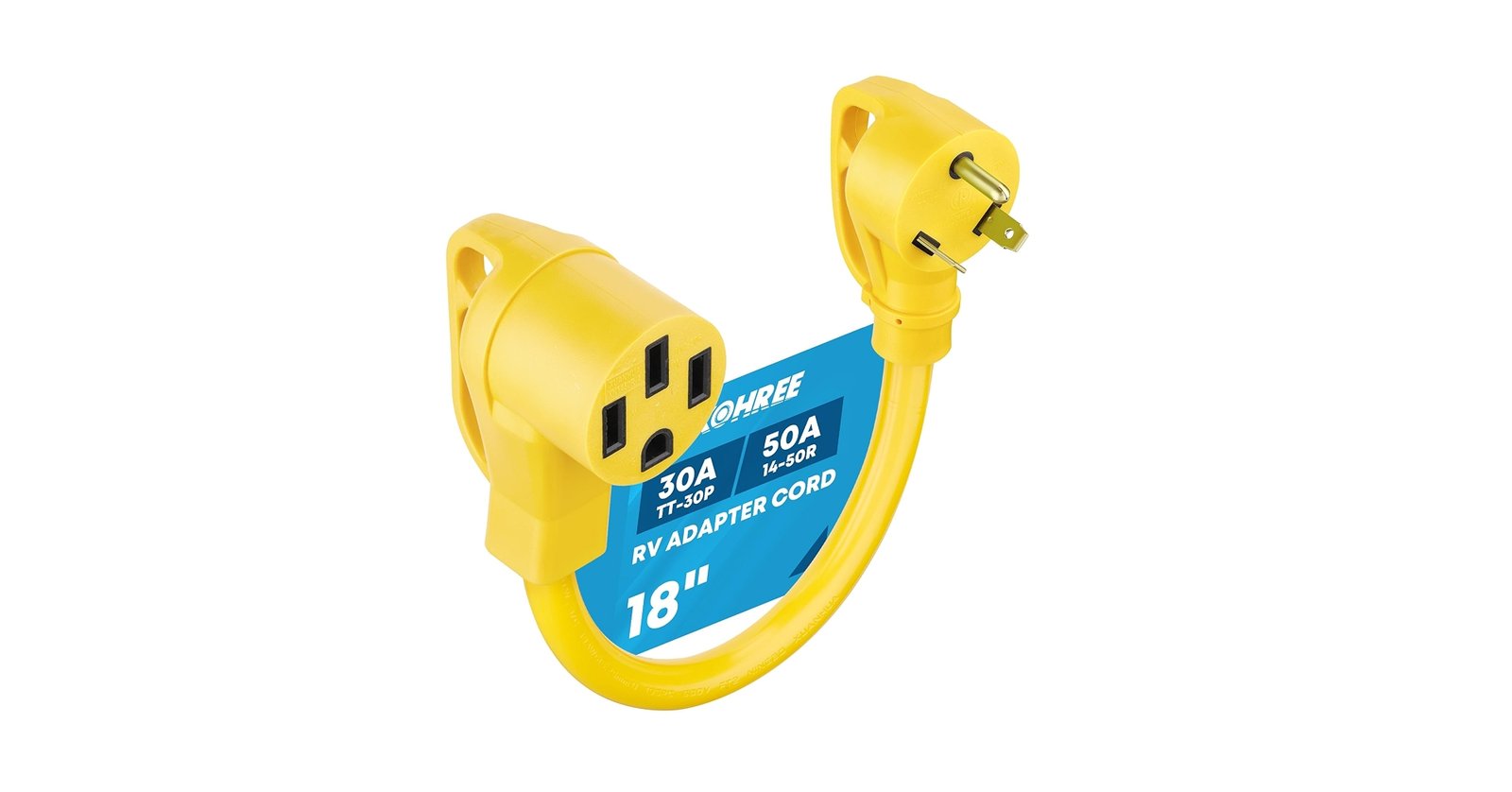
Best for: 50-amp RVs wanting a grip-handle dogbone for 30-amp pedestals.
- 30A male to 50A female dogbone adapter
- 18-inch adapter cord
- Rated 125V / 3,750W
- Grip handles for plugging and unplugging
Buying checklist
- Confirm your RV’s factory service: 30-amp TT-30 or 50-amp 14-50.
- Count air conditioners and list every high-draw appliance you expect to run together.
- Check whether the water heater, fridge, and heat can run on propane to reduce electric load.
- Match cord, adapter, surge protector, and generator outlet to the same service rating.
- Read the owner’s manual for load-management guidance.
FAQ
Is 50-amp RV service 240 volts?
It is a 120/240-volt split-phase service: each hot leg is 120 volts to neutral, and the two hot legs measure 240 volts between them. Most RV loads use 120 volts from one leg or the other; some large rigs may have specific 240-volt equipment only if the manufacturer designed it that way.
Can I plug a 30-amp RV into a 50-amp outlet?
Yes, with the correct listed adapter. Your RV remains limited to 30 amps, and its main breaker should trip before the RV wiring is overloaded. The adapter does not add capacity.
Can a 50-amp RV run on 30 amps?
Yes, with the correct adapter, but only within the 30-amp limit. Expect to run one air conditioner and manage other loads carefully.
Bottom line
Pick 30 amp for a single-AC rig. Pick 50 amp when climate or comfort demands simultaneous heavy loads. Pair this with our propane sizing and tire load range guides.