By Michelle Johnson, SpecMyRig research desk. This review compares manufacturer specifications, published installation guidance, and recurring owner feedback. We have not claimed hands-on testing of this booster, and product links point to exact product pages for now and may be replaced with affiliate tracking links later; prices and availability can change.
weBoost Destination RV Review: Quick Verdict
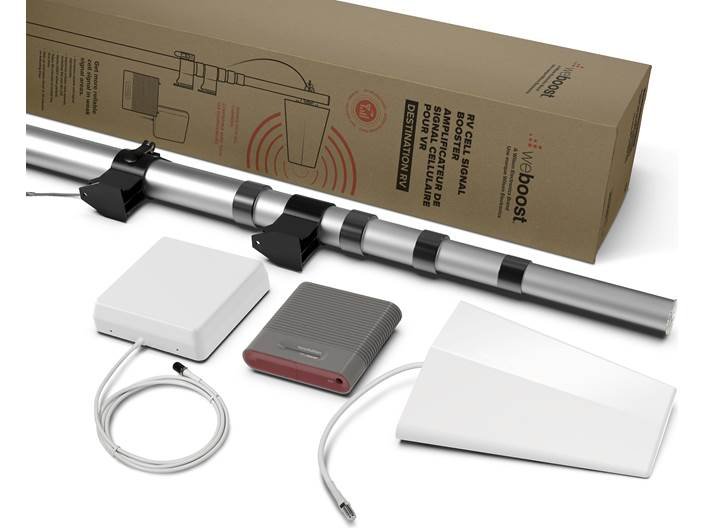
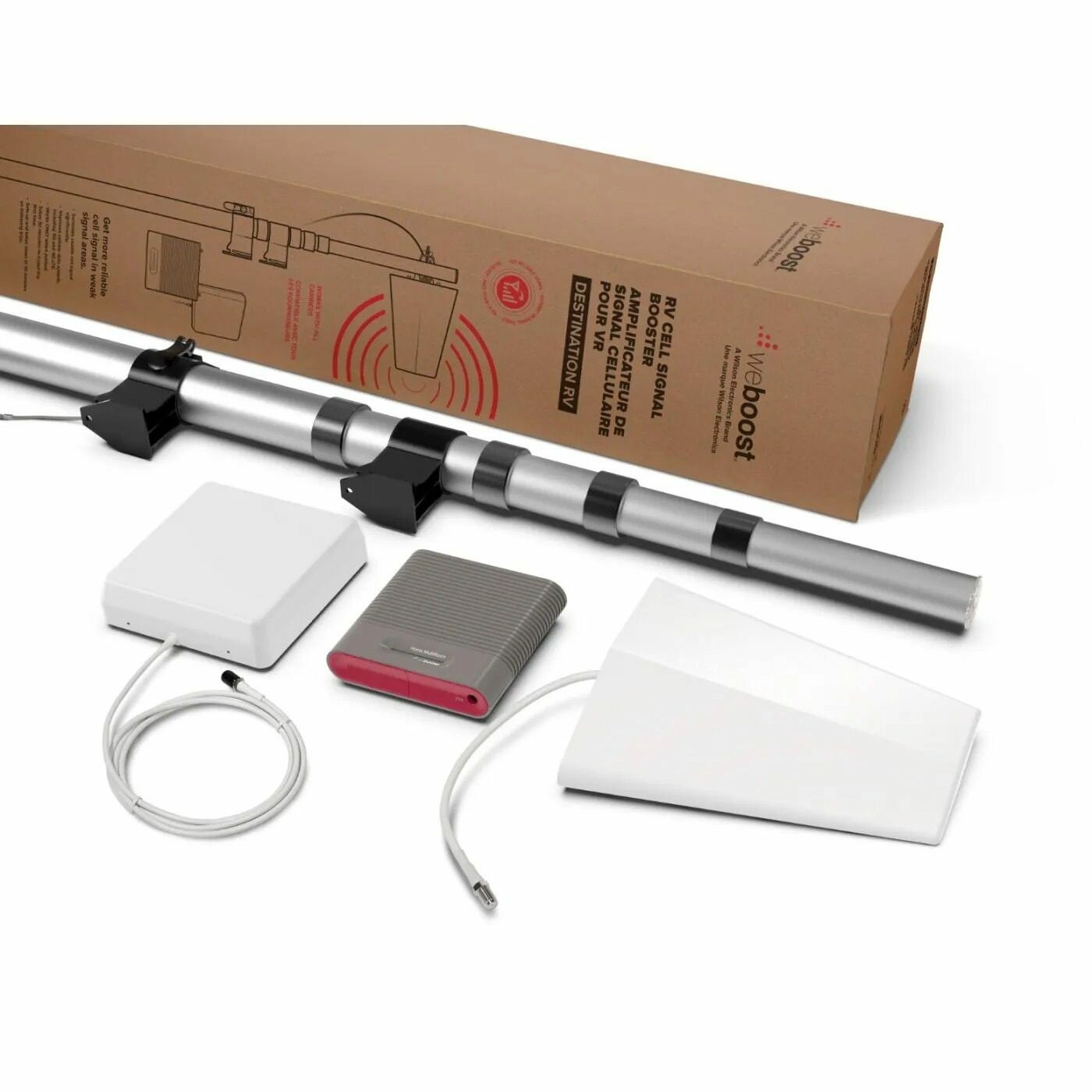
The weBoost Destination RV is a parked-only cellular booster for larger RVs, toy haulers, and trailers that stay in one place long enough to justify setup. Its appeal is straightforward: up to 65 dB maximum gain, a directional outside antenna on a telescoping pole that extends to about 24 to 25 feet, and an inside panel antenna that rebroadcasts the improved signal where you sit and work. For remote campsites with a weak but usable outside signal, that height and aim can make the difference between dropped calls and a workable connection.
The trade-off is effort: raise and aim the pole after parking, stow it before driving, and remember it cannot create service where no signal reaches the antenna.
weBoost Destination RV product images
These exact product images show the weBoost Destination RV covered in this review. Use the product link to confirm the current kit contents, price, and availability before buying.
Best for: Parked RVs needing maximum gain.
- 65 dB maximum gain for stationary, parked use
- Supports bands 12/17, 13, 5, 4, and 25/2
- Directional outside antenna on a telescoping pole
- Inside panel antenna; FCC approved
Who It Suits and Who Should Skip It
Best for
- Large RVs, fifth wheels, toy haulers, and trailers that park for multiple nights.
- Remote workers and streamers who need stronger inside signal for phones, hotspots, and cellular routers.
- Campers in fringe coverage where a phone shows a weak signal outside but struggles inside the rig.
- Owners willing to spend about 10 minutes on setup and takedown after the first installation.
Skip it if
- You need boosted signal while driving; the Destination RV is for stationary use only.
- You move every night and dislike setup tasks at each stop.
- Your campsites have no usable outside signal at all. A booster amplifies existing signal; it does not invent coverage.
- You cannot mount the pole brackets or route coax cable in a way that keeps the outside and inside antennas separated.
Key Specifications
| Feature | weBoost Destination RV (470159) |
|---|---|
| Use | Stationary RV, trailer, and toy hauler use only; stow before travel |
| Maximum gain | Up to 65 dB |
| Bands | Band 12/17 700 MHz, Band 13 700 MHz, Band 5 850 MHz, Band 4 1700/2100 MHz, Band 25/2 1900 MHz |
| Outside antenna | Directional antenna on a telescoping pole extending to about 24 to 25 feet |
| Inside antenna | Panel antenna for the living or working area |
| Cable and connectors | RG6 coax with F connectors, 75-ohm system |
| Power | AC/DC power supply and 12V hardwire option in the kit, per manufacturer kit contents |
| Setup time | Manufacturer guidance describes about 30 minutes for first installation and about 10 minutes for later setup and takedown |
| Warranty | 2-year manufacturer warranty, per published specifications |
What Matters in Real Campsites
Height and aim are the product
Most RV boosters compromise because the outside antenna sits low on a roof or ladder. The Destination RV instead raises a directional antenna on a tall pole, above the roofline and often above nearby obstructions, then lets you aim it toward the strongest tower direction. That design explains both its strength and its inconvenience. Owners who take time to rotate the antenna and check signal readings generally report better results than owners who raise the pole and hope for the best.
Inside coverage depends on separation and placement
A booster system needs distance and shielding between the outside and inside antennas. If they are too close, feedback can force the booster to reduce gain, and status lights may warn about oscillation. Place the inside panel where people actually use devices, keep cable runs tidy, and follow the installation guide for separation. Metal siding, foil insulation, and interior layout can all change how far the improved signal carries inside the rig.
Realistic expectations and cable routing
Owner feedback tends to be positive when there is a weak outside signal to work with, but results vary by carrier, tower distance, terrain, trees, and congestion. A stronger signal does not guarantee fast speeds on a busy tower or throttled plan. Plan RG6 cable routing, booster placement, power, and pole mounting around slides, doors, and awnings before the first trip.
Pros and Cons
Pros
- Up to 65 dB maximum gain, higher than typical in-motion RV boosters.
- Tall directional outside antenna can reach above the RV and be aimed at a tower.
- Supports multiple users and cellular devices inside the rig.
- Works across major carrier bands listed in the specifications.
- Inside panel antenna focuses improved signal on the living area.
Cons
- Stationary use only; it must be set up after parking and removed before driving.
- Setup and aiming take time and practice.
- Cannot help where there is no usable outside signal.
- Results depend heavily on antenna separation, placement, terrain, and carrier coverage.
- Pole, brackets, and cable runs are not ideal for every RV layout.
Buying Checklist
- Confirm your carrier uses the bands the booster supports and check coverage at your typical destinations.
- Decide where the pole brackets will mount and whether the extended pole clears awnings, slides, and trees.
- Plan the inside panel location near desks, seating, or the hotspot you use most.
- Keep outside and inside antennas separated as directed to avoid gain reduction from feedback.
- Practice aiming with a signal-reading app or phone field-test screen before relying on it for work.
- Verify the current price, kit contents, and return terms on the product page before buying.
Frequently Asked Questions
Can I use the Destination RV while driving?
No. It is designed for stationary use when parked. The pole antenna should be taken down and stowed before travel.
Will it work if my phone shows no service?
Usually not. A booster needs some existing signal at the outside antenna. The tall directional antenna may find a weak signal your phone cannot use inside the RV, but it cannot create coverage where none reaches the antenna.
Does it boost Wi-Fi from the campground?
No. It boosts cellular signal on supported bands. Campground Wi-Fi is a separate system and needs different equipment.
Bottom Line
Choose the weBoost Destination RV if you park for days, need stronger cellular signal inside a larger rig, and accept the setup routine. Choose a mobile booster instead if driving coverage matters more than maximum parked performance.
Keep comparing with our Garmin RV 795 review, Champion vs Westinghouse generator guide, and RV EMS vs surge protector guide. Read how we review and our affiliate disclosure before buying.