By Michelle Johnson, SpecMyRig research desk. This guide compares published protection specifications, manufacturer categories, and recurring owner feedback. We have not claimed laboratory surge testing, and product links point to exact product pages for now and may be replaced with affiliate tracking links later; prices and availability can change.
RV EMS vs Surge Protector: Quick Verdict
Buy an RV EMS in almost every case. A basic surge protector absorbs brief voltage spikes, such as those from nearby lightning or grid transients. An EMS, or Electrical Management System, includes surge protection and also monitors for the pedestal problems that damage RVs more often: low voltage, high voltage, open ground, open neutral, reverse polarity, and frequency faults. When it detects unsafe power, it disconnects the RV and reconnects after a delay when conditions return to normal.
That disconnect is the product: it refuses voltage sag and wiring faults before they stress your air conditioner, converter, and electronics.
Who Each Option Suits
Choose an EMS if
- You plug into campground pedestals regularly, especially older or crowded parks.
- Your RV has rooftop air conditioning, a converter or inverter-charger, residential refrigerator, microwave, or other electronics worth protecting.
- You want automatic disconnect and delayed reconnect instead of relying on warning lights.
A basic surge protector may be enough if
- You only need spike absorption for a simple rig and understand that it will not disconnect for low voltage or wiring faults.
- You are replacing a sacrificial surge device in a setup that already has separate electrical monitoring and disconnect protection.
Skip both until you check if
- You do not know whether your RV is 30-amp or 50-amp service. Match protection to your RV plug and service, even when using adapters.
- You are considering a voltage booster or autoformer instead. Those devices correct low voltage by boosting it; they are related but not identical to an EMS.
What Each Device Actually Does
Basic surge protector: spike absorption only
A surge protector uses metal-oxide varistors, often called MOVs, to absorb brief high-voltage spikes. The joule rating describes how much surge energy it can absorb before it is spent. Better models add indicator lights for wiring faults or protection status, but lights do not disconnect power. If voltage sags to damaging levels for minutes, a surge-only device generally does nothing.
EMS: monitoring plus automatic disconnect
An EMS pairs surge absorption with a microprocessor and a contactor that can physically disconnect the RV. Published specifications from major brands commonly describe low-voltage cutoff around 102 to 104 volts, high-voltage cutoff around 132 volts, detection of open ground, open neutral, and reverse polarity, and a restart delay after power returns. Exact thresholds and delays vary by model, so read the specification sheet for the unit you choose.
Protection is not correction
An EMS protects by refusing unsafe power. An autoformer or voltage booster tries to correct low voltage by boosting it toward a usable range. Some products combine functions, but the categories should not be confused. If a park chronically sags, an EMS may disconnect often because it is doing its job. That can be frustrating, but it is safer than letting motors strain at low voltage.
Comparison Table
| Pedestal problem | Basic surge protector | RV EMS |
|---|---|---|
| Voltage spike or nearby lightning transient | Absorbs surge energy sacrificially | Absorbs surge energy and can disconnect |
| Low voltage during hot, crowded afternoons | Usually no protection | Disconnects below its low-voltage threshold |
| Sustained high voltage | No sustained correction | Disconnects above its high-voltage threshold |
| Open ground | Warning light on some models | Detects and refuses power |
| Open neutral | Warning light on some models | Detects and refuses power |
| Reverse polarity | Warning light on some models | Detects and refuses power |
| Generator frequency drift | No protection | Disconnects on frequency faults on models that monitor frequency |
| Air conditioner rapid restart after outage | No delay | Timed reconnect delay helps compressor pressure equalize |
| Information display | Basic lights | Display, error codes, or app monitoring depending on model |
Portable vs Hardwired EMS
Portable, hardwired, and brand naming
A portable EMS plugs into the pedestal and is easy to move or replace, but it faces weather and theft risk, so look for weather resistance and a lock. A hardwired EMS installs inside near the breaker panel or inlet, stays protected, and cannot be forgotten, but needs competent installation. Progressive Industries, Hughes Power Watchdog, and Southwire Surge Guard use different labels, so verify functions rather than marketing: joules, voltage disconnect thresholds, ground and neutral detection, reverse polarity detection, restart delay, display or app, and amp rating.
Pros and Cons
EMS
- Pros: protects against spikes and the common faults that damage RV electronics, disconnects automatically, delays reconnect for air conditioner protection, provides clearer fault information.
- Cons: costs more than surge-only devices, may disconnect in weak parks, portable units can be stolen or weather-exposed, hardwired units need installation.
Basic surge protector
- Pros: lower cost and simple plug-in use.
- Cons: does not disconnect for low voltage or wiring faults, protection is sacrificial, warning lights require you to notice and act.
Best 5 RV EMS and surge protectors
These five picks separate full EMS protection from basic surge protection. Choose portable or hardwired by how often you change rigs, and match the device to 30-amp or 50-amp service before buying.
1. Progressive Industries EMS-PT30X
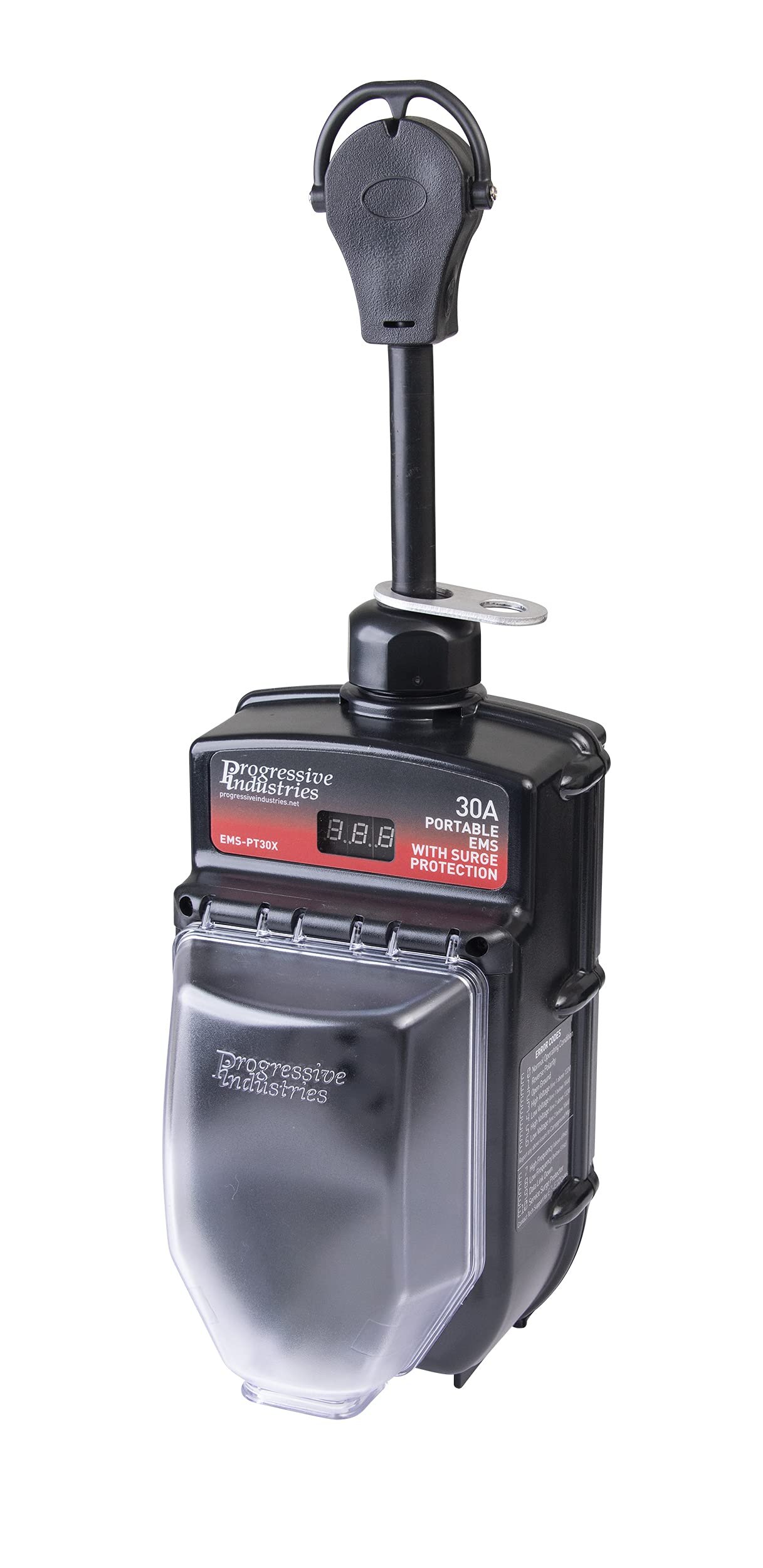
Best for: 30-amp RVs wanting portable EMS protection with a built-in display.
- 30A / 120V / 3,600W portable EMS
- 3-mode surge protection rated 1,790J / 44,000A max spike
- Integrated digital display
- Over/under-voltage and wiring-fault protection
2. Progressive Industries EMS-HW50C
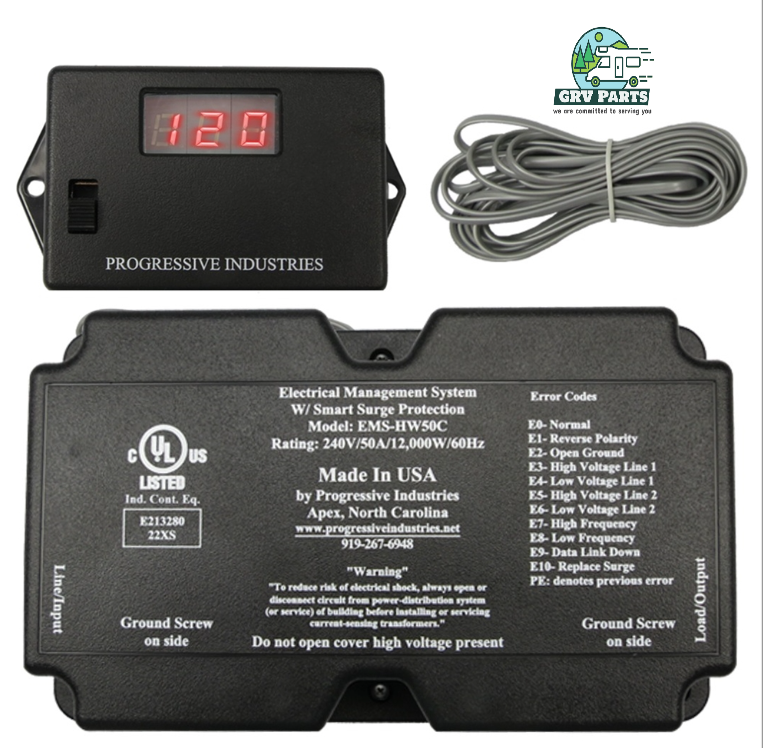
Best for: 50-amp RVs wanting hardwired EMS protection.
- Hardwired 50A EMS for 120/240V service
- Rated 12,000W
- Surge protection capacity 3,580J / 88,000A max spike
- Remote digital display and cable included
3. Hughes Power Watchdog PWD30-EPO
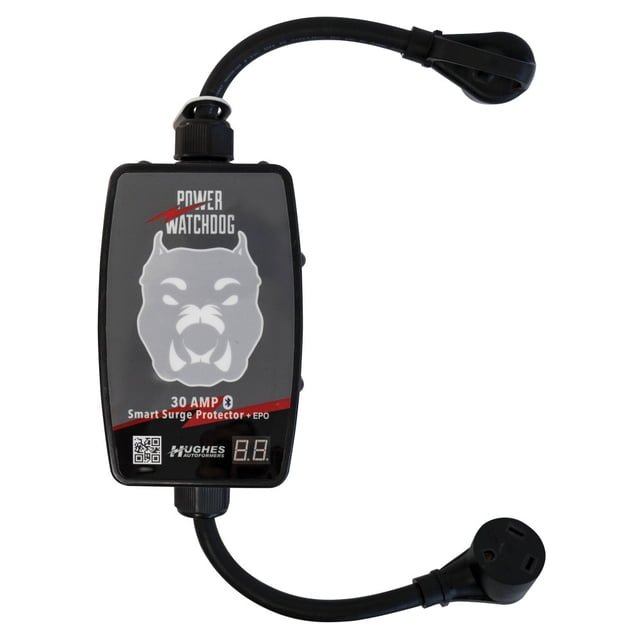
Best for: 30-amp RVs wanting Bluetooth power monitoring with automatic shutoff.
- 30A portable surge protector with EPO shutoff
- 3,000J surge capacity
- Bluetooth monitoring of voltage, amperage, and wattage
- Shuts off below 104V or above 132V and restores after stable power
4. Southwire Surge Guard 34930
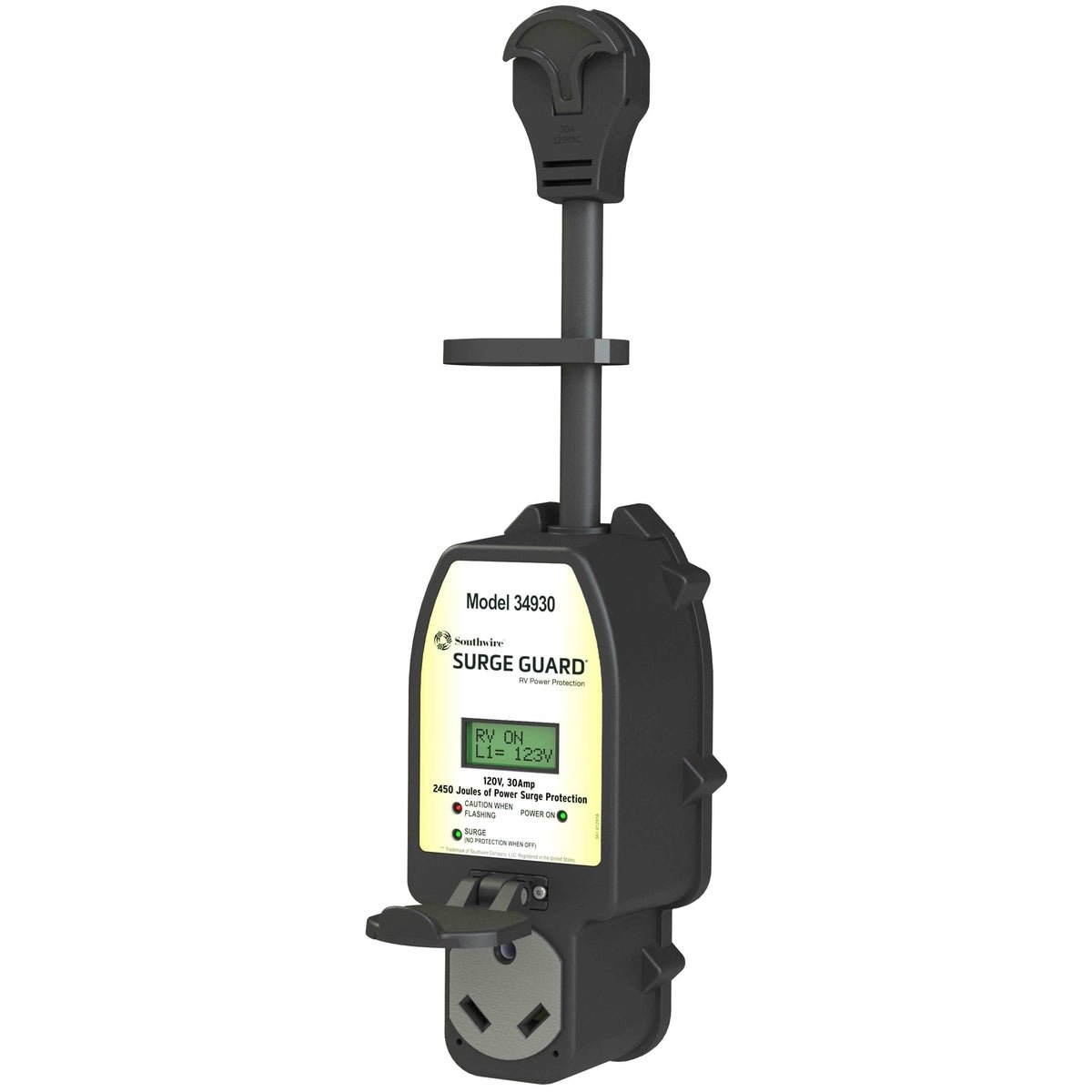
Best for: 30-amp RVs wanting an LCD readout without Bluetooth.
- 30A / 120V / 3,600W portable surge guard
- 2,450J surge capacity
- LCD displays voltage and amp draw
- Low/high voltage protection below 102V / above 132V with 128-second reset delay
5. Camco Power Grip 30-Amp Voltage Protector 55301
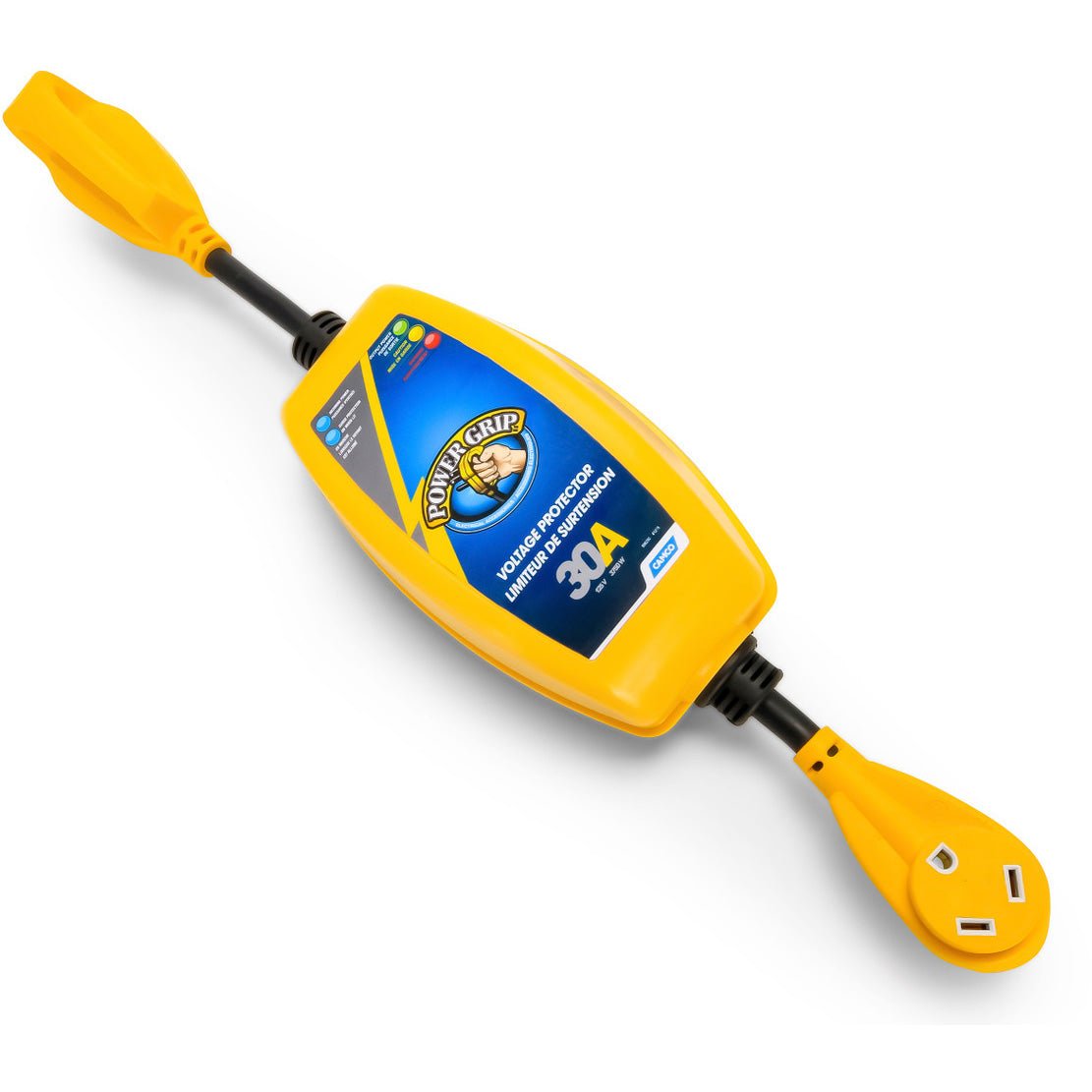
Best for: 30-amp RVs wanting a compact voltage protector with diagnostic LEDs.
- 30A male NEMA TT-30P to 30A female NEMA TT-30R
- Integrated surge protection up to 2,800J
- Protects against high voltage above 132 VAC and low voltage below 102 VAC
- Diagnostic LEDs indicate wiring faults
Buying Checklist
- Match the device to your RV service: 30-amp protection for a 30-amp rig, 50-amp protection for a 50-amp rig.
- Confirm it is a true EMS with automatic disconnect, not only a surge protector with indicator lights.
- Compare low-voltage and high-voltage thresholds, open ground and neutral detection, reverse polarity detection, and restart delay.
- Check surge joule rating, weather resistance, display or app monitoring, and replaceable surge modules if offered.
- Decide portable versus hardwired based on theft risk, installation comfort, and whether you change rigs often.
- Verify the current price, warranty, and return terms on the product page before buying.
Frequently Asked Questions
Is an EMS the same as a surge protector?
No. An EMS includes surge protection but adds continuous monitoring and automatic disconnect for voltage and wiring faults. A basic surge protector mainly absorbs spikes.
Why is low voltage dangerous for an RV?
Motors such as air conditioner compressors draw more current and run hotter when voltage sags. Sustained low voltage can shorten motor life or cause failure, especially during hot weather.
Should I buy 30-amp or 50-amp protection?
Match your RV service and shore cord. Using an adapter does not turn a 30-amp rig into a 50-amp rig or make mismatched protection correct.
Bottom Line
If you plug into campground power, an EMS is the safer default. A surge protector covers the rare spike; an EMS covers spikes plus the low-voltage and wiring faults that actually threaten RV electronics.
Continue with our Champion vs Westinghouse generator guide, 6-volt vs 12-volt RV batteries guide, and Garmin RV 795 review. Read how we review and our affiliate disclosure before buying.